
#VietnamRealAssets #AssetAcquisitionIntelligence #ExclusiveDealFlow #InstitutionalInvesting #UHNW
Field Notes on Red Spinel: What Capital Cannot See from Conference Rooms
Part One: The Office Call
The family office manager sat in a Milwaukee high-rise, looking at spreadsheets. His name was Richard. He had attended three conferences on alternative asset diversification. He knew the talking points. Gemstone sourcing offered non-correlated returns. Vietnam held untapped reserves. The numbers looked clean on his screen.
He called me on a Wednesday.
"We're interested in red spinel as a hedge against currency volatility," he said. "What's your sourcing strategy? We need quarterly reports and third-party authentication."
I was standing in Luc Yen, a mining region in northern Vietnam. The signal was weak. I had maybe four minutes before the connection dropped.
"I'll send you something," I said.
Part Two: Ground Level
The mine entrance looked like a scar. Not dramatic. Just a hole where the earth had been moved. Tuan, the site manager, was forty-three and had worked gemstones for twenty-two years. He had a notebook with dates, weights, and grades written in blue ink. No computer. No cloud backup.
"How many kilos this week?" I asked.
"Maybe thirty," he said. "Quality mixed. Some good. Some not."
We walked down. The shaft was narrow. The ladder was wood and rope. The air was damp and still. Four miners were working below, using hand tools. One had a headlamp. The others worked by natural light coming through the entrance, which meant they stopped working by 5 p.m. every day.
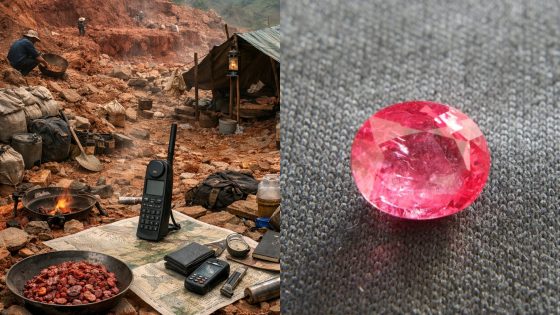
I made notes on paper. Sketches of the deposit layers. A small map showing where the richer pockets were forming. I checked my phone. One bar of signal. I took photographs of the stones they had pulled that morning. Red spinel, some pink, some darker. Rough. Uncut.
"These stones," I said to Tuan. "Can you show me the extraction point?"
He pointed to a specific wall section. The spinel was embedded in a matrix of lighter rock. The miners had to work slowly or the stones would crack. This was not something you could speed up. This was not something you could fake from an office.
Part Three: The Report That Never Arrives Clean
Back at the small house where I was staying, I charged my phone using the solar panel. It took eight hours. While it charged, I wrote out the week's data by hand. Thirty kilograms pulled. Approximately seven kilograms of gem-quality material. The rest would go to industrial use or be discarded. That was the reality. Capital expected higher yields. The ground did not care what capital expected.
I typed a summary and sent it to Richard's email. No graphs. No projections. Just the numbers.
He replied the next day. "This yield seems low. Other suppliers are reporting 40 percent recovery rates from rough material."
I called him again, standing outside the house at dawn before the signal faded.
"Some suppliers are lying," I said. "Or they're mixing in stones from other regions and calling it Luc Yen sourcing."
There was silence.
"Can you verify that?" he asked.
"I can show you the extraction site. I can introduce you to the miners. I can show you my notes from every day. That's the verification. Everything else is guesswork."
Part Four: What Capital Wants Versus What Exists
Richard wanted a report that showed consistent supply, predictable margins, and authenticated origin. Those things did not exist in the way he imagined them. What existed was this: a small team of experienced miners, a specific geographic location with measurable deposits, physical limitations based on labor and time, and honest accounting of what came out of the ground.
The moment a family office sees real numbers from the field, it clicks. Richard began to understand that alternative asset sourcing in gemstones was not about finding hidden alpha. It was about finding something real in a market where many participants offered fiction.
By February 2026, when Lunar New Year approached, Tuan would be preparing for the holiday shutdown. The miners would return to their families. The extraction would pause for two weeks. This was not a surprise. This was scheduled. Capital could plan around it or could not. The ground would wait either way.
Part Five: Sourcing Without the Guesswork
Some funds fake results. Some spinel fake origin. We check both at source. This meant physical presence.
In a village outside Hanoi, the family office manager held the spinel sample under lamplight, turning it slowly between his fingers. The sketch beside him showed the mine coordinates, depth, and extraction date in my handwriting. He asked one question: "You pulled this yesterday?" When I nodded, something shifted in his expression. He'd seen certificates before, seen promises. But holding stone still warm from the ground, watching the lamp reflect off its surface, made the difference between believing a spreadsheet and believing in actual value sitting in his palm.
My phone charged once daily from the solar panel, giving me one window to send photos and data back. The family office received a message with GPS coordinates, soil composition notes, and a timestamp from that morning. No intermediaries had touched the information. No brokers had filtered it. The manager told me later that single verified detail—knowing exactly when and where the sample came from without any chain of custody gaps—changed how they evaluated every other acquisition pitch they received that quarter.
#ExclusiveDealFlow
Three competing funds wanted access to the same mining site. I could only take one of them into the field. The fund that got chosen was the one whose manager asked about my medical kit and the nearest hospital, not about projected returns. That question told me they understood what exclusive access actually meant: someone willing to verify claims by standing where the asset exists, accepting real risk to confirm real value instead of relying on third-party reports written in comfortable offices.
#InstitutionalInvesting
The beacon sat in my pack next to the medical kit, both untouched. A senior institutional investor asked why I'd bring safety equipment to a routine site visit. I explained the 200-mile distance to care, the conditions, the actual stakes. His response was immediate: "That's why we're here instead of buying through a middleman." Institutions serious about assets want to know the people doing the work understand what can go wrong and still choose to verify in person rather than trust distant assurances.
#UHNW
The ultra-high-net-worth individual's family office manager spent three days in the field with me, sleeping poorly, eating basic food, watching me sketch coordinates by fading daylight. On the final evening, he said most managers who approached them claimed expertise but had never actually stood on the ground where their recommendations came from. Being willing to experience the difficulty of verification, he explained, was the only real proof that someone understood the difference between managing money and managing actual assets.