
After three decades in the field
I’ve seen how the noise grew louder, and how the truth quietly stayed behind.
The Noise Everyone Hears
Everywhere you look, it’s the same slogans.
“Direct sourcing.” “Investment-grade.” “Untreated rarity.”
Everyone repeats them like a chorus, chasing attention.
Most of them have never stood near a real cutting bench.
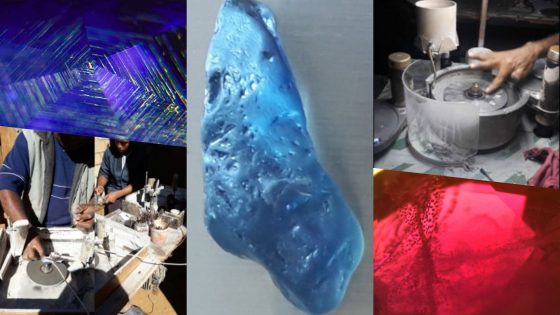
Never smelled the heat off a copper plate when it bites into a stone.
Never heard the dry scrape of diamond grit turning against metal.
That’s what the trade really sounds like, not music, not marketing, just friction and patience.
I’ve been in those rooms, Sri Lanka, Madagascar, Colombia.
Hot air, dim light, a few tools older than the cutter himself.
That’s where value is made and destroyed in the same breath.
For readers who want to see how these sourcing realities look on the ground, visit GemstonePortfolio Fieldnotes.
What the Field Still Knows
One afternoon in Ratnapura, I watched a cutter chase brilliance too far.
The stone was ready, clean, balanced, but greed for perfection is stronger than reason.
He pressed harder. The sound changed, too sharp, too dry, and then it was gone.
Nothing left but metallic smell and dust.
We both just laughed.
What else can you do when something that rare disappears right in front of you?
That’s the line you live on in this trade, one step past perfect and everything turns to powder.
A week later another cutter took one of my roughs.
He didn’t lose it by mistake. He killed it on purpose.
Said I had too much luck, too good an eye for the rough.
He wanted to even it out.
So he cut until there was nothing left to envy.
That was the last stone he touched for me.
I packed the rest and found a new bench, someone who could see what I see,
someone who knew when to stop.
Because that’s the real art.
Knowing when to stop.
The Heat Game
I’ve had dealers try to pass heated rough as natural.
They look you straight in the eye and swear it’s from the mine “as is.”
You don’t even need a loupe once you’ve handled enough.
After a few thousand pieces, your hands know before your eyes do.
The cooked ones feel wrong.
The surface looks sealed, like the heat closed every pore.
And the color, that dead, perfect blue.
Too perfect to be alive.
A real stone moves.
You turn it in your hand and it shifts, a breath of violet, a touch of grey, a whisper of green when daylight hits it right.
That’s what life looks like inside a stone.
The heated ones don’t move.
No pulse, no change.
You can turn them all day and they’ll stay the same dead blue.
One man in Ratnapura once spread a parcel on the table, dozens of pieces, all the same lifeless shade.
He waited for a reaction.
I picked one up, turned it under the light, and said, “You melted it to death.”
He didn’t know if I was joking. I was, but not really.
Then we both laughed, because what else can you do?
A good stone died twice, once in the furnace, and again when someone called it investment-grade.
They call it investment-grade.
I call it cremated.
Whatever life it had, gone long before it reached me.
The Turn
Then once in a while, something different lands on the table.
You pick it up expecting more of the same dead blue, but the light hits and everything changes.
It breathes. It moves.
The color bends with you, blue to grey, grey to violet, like it’s still remembering where it came from.
That’s when you know it’s real.
No need for paper, no lab, no proof.
Just the pulse of something untouched.
I’ve found stones like that in the middle of cooked parcels.
The dealer doesn’t even notice.
He’s looking for “perfect color,” I’m looking for life.
And when you see it, you stop talking.
You just know.
The Circle of Trust
These days I work with a small group of lapidarists, men who each have more than thirty years of cutting behind them.
No students, no pretenders, just steady hands that have seen it all.
We don’t need long talks. There’s trust now, on both sides, but it wasn’t always like that.
At first, they didn’t take me seriously.
They smiled politely, kept their own rhythm, and probably thought, another foreigner with theories.
Then one day I guided one of them through a cut I had only in my head.
No diagram, no plan, just a picture I could see in the rough.
He laughed at first, thought I was guessing.
But he followed, slow and careful.
When the last facet was done, he held it to the light and went quiet.
Then he looked at me, smiled, and said, “Alright. You saw it before I did.”
That was the turning point.
Since then, we work together in full trust.
No secrets, no second-guessing.
They know I see what they see, and I know they’ll stop cutting right before the brilliance turns to glare.
That’s the trade as it should be, a few hands, a few eyes, and enough respect to keep the work honest.
For readers exploring how this trust carries into modern collecting and strategy, visit GemstonePortfolio Investment Pathways.